


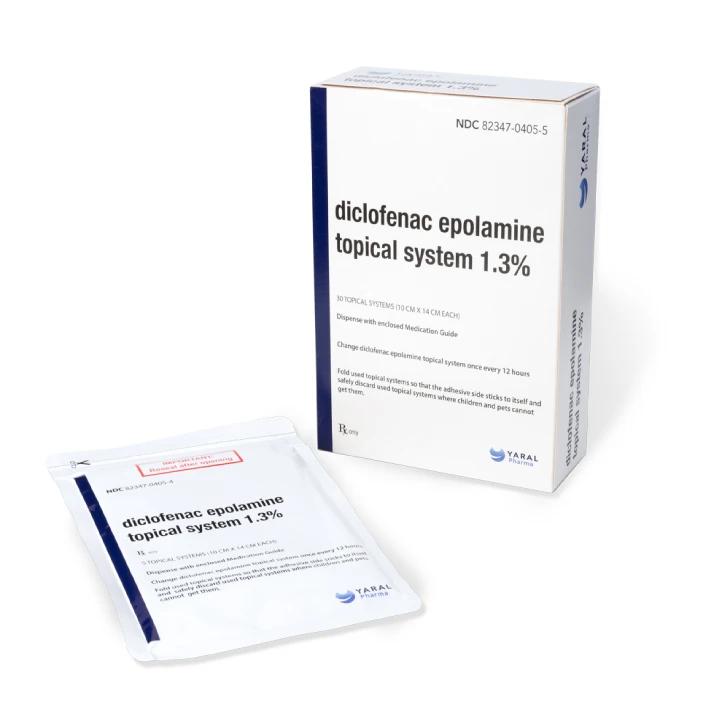
Diclofenac Epolamine 1.3%
$105.00 / 30 Patches
$45 Telehealth visit fee required
- Low systemic exposure for acute pain management.
- Significant pain relief within 4-hours after first application. Sustained pain reduction 7-days with twice-daily application.² ³
- Patented patch technology delivers NSAID impact for 12-hours.⁴
- Use exactly as prescribed at the lowest dose possible for the shortest time needed. The recommended dose is one (1) topical patch to the most painful area twice a day.
$45 Telehealth visit fee required
1. Diclofenac epolamine topical system 1.3% [package insert]. Parsippany, NJ: YARAL Pharma Inc; 2020.
2. Lionberger DR, Joussellin E, Lanzarotti A, Yanchick J, Magelli M. Diclofenac epolamine topical patch relieves pain associated with ankle sprain. J Pain Res. 2011;4:47-53. Published 2011 Mar 7. doi:10.2147/JPR.S15380
3. Kuehl K, Carr W, Yanchick J, Magelli M, Rovati S. Analgesic effi cacy and safety of the diclofenac epolamine topical patch 1.3% (DETP) in minor soft tissue injury. Int J Sports Med. 2011;32(8):635-643. doi:10.1055/s-0031-1275359
4. K.D. Rainsford et al., Curr Med Research Opin.; 2018; 35(6): 989-1002
A Different Way to Treat Acute Pain
For many patients suffering from acute pain due to a strain or sprain, an oral medication may deliver relief systemically when only localized action is needed. That’s why Diclofenac Epolamine Topical System 1.3% is a prescription NSAID topical system designed to deliver pain-reducing medicine directly to where it hurts. Its localized delivery offers low potential for systemic exposure compared to oral options.

Understanding Acute Pain
Acute pain is short-term pain, often described as a stabbing, burning, or squeezing sensation. It can result from minor injuries, including strains, sprains, and contusions (bruises). While acute pain may be brief, it is a signal of tissue damage. The goal of treatment is to reduce the pain, redness, swelling, and heat (inflammation) associated with these injuries.

Treat Acute Pain Exactly Where it Hurts
Many individuals are seeking alternatives to traditional oral pain relievers. A topical NSAID system in your pain management toolbox may provide support when you need it most. Diclofenac Epolamine Topical System 1.3% offers a 12-hour, mess-free patch application with localized absorption, giving you a proven choice for treating acute pain exactly where it hurts.

USE & IMPORTANT SAFETY INFORMATION
INDICATIONS AND USAGE
DICLOFENAC EPOLAMINE TOPICAL SYSTEM 1.3% is a nonsteroidal anti-inflammatory drug (NSAID) and is indicated for the topical treatment of acute pain due to minor strains, sprains, and contusions in adults and pediatric patients 6 years and older.
IMPORTANT SAFETY INFORMATION
WARNING: RISK OF SERIOUS CARDIOVASCULAR and GASTROINTESTINAL EVENTS
Cardiovascular Thrombotic Events
- Nonsteroidal anti-inflammatory drugs (NSAIDs) cause an increased risk of serious cardiovascular thrombotic events, including myocardial infarction and stroke, which can be fatal. This risk may occur early in the treatment and may increase with duration of use.
- DICLOFENAC EPOLAMINE TOPICAL SYSTEM 1.3% is contraindicated in the setting of coronary artery bypass graft (CABG) surgery.
Gastrointestinal Bleeding, Ulceration, and Perforation
- NSAIDs cause an increased risk of serious gastrointestinal (GI) adverse events including bleeding, ulceration, and perforation of the stomach or intestines, which can be fatal. These events can occur at any time during use and without warning symptoms. Elderly patients and patients with a prior history of peptic ulcer disease and/or GI bleeding are at greater risk for serious GI events.
CONTRAINDICATIONS
DICLOFENAC EPOLAMINE TOPICAL SYSTEM 1.3% is contraindicated in the following patients:
- Known hypersensitivity (e.g., anaphylactic reactions and serious skin reactions) to diclofenac or any components of the drug product.
- History of asthma, urticaria, or other allergic-type reactions after taking aspirin or other NSAIDs. Severe, sometimes fatal, anaphylactic reactions to NSAIDs have been reported in such patients.
- In the setting of coronary artery bypass graft (CABG) surgery.
- On non-intact or damaged skin resulting from any etiology, including exudative dermatitis, eczema, infected lesions, burns or wounds.
WARNINGS AND PRECAUTIONS
- Hepatotoxicity: Inform patients of warning signs and symptoms of hepatotoxicity. Discontinue if abnormal liver tests persist or worsen or if clinical signs and symptoms of liver disease develop.
- Hypertension: Patients taking some antihypertensive medications may have impaired response to these therapies when taking NSAIDs. Monitor blood pressure.
- Heart Failure and Edema: Avoid use of DICLOFENAC EPOLAMINE TOPICAL SYSTEM 1.3% in patients with severe heart failure unless benefits are expected to outweigh risk of worsening heart failure.
- Renal Toxicity: Monitor renal function in patients with renal or hepatic impairment, heart failure, dehydration, or hypovolemia. Avoid use of DICLOFENAC EPOLAMINE TOPICAL SYSTEM 1.3% in patients with advanced renal disease unless benefits are expected to outweigh risk of worsening renal function.
- Anaphylactic Reactions: Seek emergency help if an anaphylactic reaction occurs.
- Exacerbation of Asthma Related to Aspirin Sensitivity: DICLOFENAC EPOLAMINE TOPICAL SYSTEM 1.3% is contraindicated in patients with aspirin-sensitive asthma. Monitor patients with preexisting asthma (without aspirin sensitivity).
- Serious Skin Reactions: Discontinue DICLOFENAC EPOLAMINE TOPICAL SYSTEM 1.3% at first appearance of skin rash or other signs of hypersensitivity.
- Drug Reaction with Eosinophilia and Systemic Symptoms (DRESS): Discontinue and evaluate clinically.
- Fetal Toxicity: Limit use of NSAIDs, including DICLOFENAC EPOLAMINE TOPICAL SYSTEM 1.3%, between about 20 to 30 weeks in pregnancy due to the risk of oligohydramnios/ fetal renal dysfunction. Avoid use of NSAIDs in women at about 30 weeks gestation and later in pregnancy due to the risks of oligohydramnios/fetal renal dysfunction and premature closure of the fetal ductus arteriosus.
- Hematologic Toxicity: Monitor hemoglobin or hematocrit in patients with any signs or symptoms of anemia.
ADVERSE REACTIONS
The most common adverse reactions in DICLOFENAC EPOLAMINE TOPICAL SYSTEM 1.3% and placebo-treated adult patients were pruritus (5% and 8%, respectively) and nausea (3% and 2%, respectively). The most common adverse reactions in DICLOFENAC EPOLAMINE TOPICAL SYSTEM 1.3% treated pediatric patients were headache (9%) and application site pruritus (7%).
To report SUSPECTED ADVERSE REACTIONS, contact YARAL Pharma Professional Information Service at 1-866-218-9009 or FDA at 1-800-FDA-1088 or www.fda.gov/medwatch.
Please see Full Prescribing Information, including Boxed Warning for DICLOFENAC EPOLAMINE TOPICAL SYSTEM 1.3%.
For more information: info@yaralpharma.com 1-866-218-9009 • www.yaralpharma.com
YARAL Pharma Inc., 8 Campus Drive, Suite 201A, Parsippany, NJ 07054 © 2025 YARAL Pharma Inc. All rights reserved. YPM-1381-v1. for DICLOFENAC EPOLAMINE TOPICAL SYSTEM 1.3%
INDICATIONS AND USAGE
DICLOFENAC EPOLAMINE TOPICAL SYSTEM 1.3% is a nonsteroidal anti-inflammatory drug (NSAID) and is indicated for the topical treatment of acute pain due to minor strains, sprains, and contusions in adults and pediatric patients 6 years and older.
IMPORTANT SAFETY INFORMATION
WARNING: RISK OF SERIOUS CARDIOVASCULAR and GASTROINTESTINAL EVENTS
Cardiovascular Thrombotic Events
- Nonsteroidal anti-inflammatory drugs (NSAIDs) cause an increased risk of serious cardiovascular thrombotic events, including myocardial infarction and stroke, which can be fatal. This risk may occur early in the treatment and may increase with duration of use.
- DICLOFENAC EPOLAMINE TOPICAL SYSTEM 1.3% is contraindicated in the setting of coronary artery bypass graft (CABG) surgery.
Gastrointestinal Bleeding, Ulceration, and Perforation
- NSAIDs cause an increased risk of serious gastrointestinal (GI) adverse events including bleeding, ulceration, and perforation of the stomach or intestines, which can be fatal. These events can occur at any time during use and without warning symptoms. Elderly patients and patients with a prior history of peptic ulcer disease and/or GI bleeding are at greater risk for serious GI events.
CONTRAINDICATIONS
DICLOFENAC EPOLAMINE TOPICAL SYSTEM 1.3% is contraindicated in the following patients:
- Known hypersensitivity (e.g., anaphylactic reactions and serious skin reactions) to diclofenac or any components of the drug product.
- History of asthma, urticaria, or other allergic-type reactions after taking aspirin or other NSAIDs. Severe, sometimes fatal, anaphylactic reactions to NSAIDs have been reported in such patients.
- In the setting of coronary artery bypass graft (CABG) surgery.
- On non-intact or damaged skin resulting from any etiology, including exudative dermatitis, eczema, infected lesions, burns or wounds.
WARNINGS AND PRECAUTIONS
- Hepatotoxicity: Inform patients of warning signs and symptoms of hepatotoxicity. Discontinue if abnormal liver tests persist or worsen or if clinical signs and symptoms of liver disease develop.
- Hypertension: Patients taking some antihypertensive medications may have impaired response to these therapies when taking NSAIDs. Monitor blood pressure.
- Heart Failure and Edema: Avoid use of DICLOFENAC EPOLAMINE TOPICAL SYSTEM 1.3% in patients with severe heart failure unless benefits are expected to outweigh risk of worsening heart failure.
- Renal Toxicity: Monitor renal function in patients with renal or hepatic impairment, heart failure, dehydration, or hypovolemia. Avoid use of DICLOFENAC EPOLAMINE TOPICAL SYSTEM 1.3% in patients with advanced renal disease unless benefits are expected to outweigh risk of worsening renal function.
- Anaphylactic Reactions: Seek emergency help if an anaphylactic reaction occurs.
- Exacerbation of Asthma Related to Aspirin Sensitivity: DICLOFENAC EPOLAMINE TOPICAL SYSTEM 1.3% is contraindicated in patients with aspirin-sensitive asthma. Monitor patients with preexisting asthma (without aspirin sensitivity).
- Serious Skin Reactions: Discontinue DICLOFENAC EPOLAMINE TOPICAL SYSTEM 1.3% at first appearance of skin rash or other signs of hypersensitivity.
- Drug Reaction with Eosinophilia and Systemic Symptoms (DRESS): Discontinue and evaluate clinically.
- Fetal Toxicity: Limit use of NSAIDs, including DICLOFENAC EPOLAMINE TOPICAL SYSTEM 1.3%, between about 20 to 30 weeks in pregnancy due to the risk of oligohydramnios/ fetal renal dysfunction. Avoid use of NSAIDs in women at about 30 weeks gestation and later in pregnancy due to the risks of oligohydramnios/fetal renal dysfunction and premature closure of the fetal ductus arteriosus.
- Hematologic Toxicity: Monitor hemoglobin or hematocrit in patients with any signs or symptoms of anemia.
ADVERSE REACTIONS
The most common adverse reactions in DICLOFENAC EPOLAMINE TOPICAL SYSTEM 1.3% and placebo-treated adult patients were pruritus (5% and 8%, respectively) and nausea (3% and 2%, respectively). The most common adverse reactions in DICLOFENAC EPOLAMINE TOPICAL SYSTEM 1.3% treated pediatric patients were headache (9%) and application site pruritus (7%).
To report SUSPECTED ADVERSE REACTIONS, contact YARAL Pharma Professional Information Service at 1-866-218-9009 or FDA at 1-800-FDA-1088 or www.fda.gov/medwatch.
Please see Full Prescribing Information, including Boxed Warning for DICLOFENAC EPOLAMINE TOPICAL SYSTEM 1.3%.
For more information: info@yaralpharma.com 1-866-218-9009 • www.yaralpharma.com
YARAL Pharma Inc., 8 Campus Drive, Suite 201A, Parsippany, NJ 07054 © 2025 YARAL Pharma Inc. All rights reserved. YPM-1381-v1. for DICLOFENAC EPOLAMINE TOPICAL SYSTEM 1.3%